
When a fitness business invests in SEO, the goal is straightforward: become more visible to local searchers and convert that visibility into meaningful engagement. However, without clear tracking and a consistent strategy, it’s difficult to know what’s working.
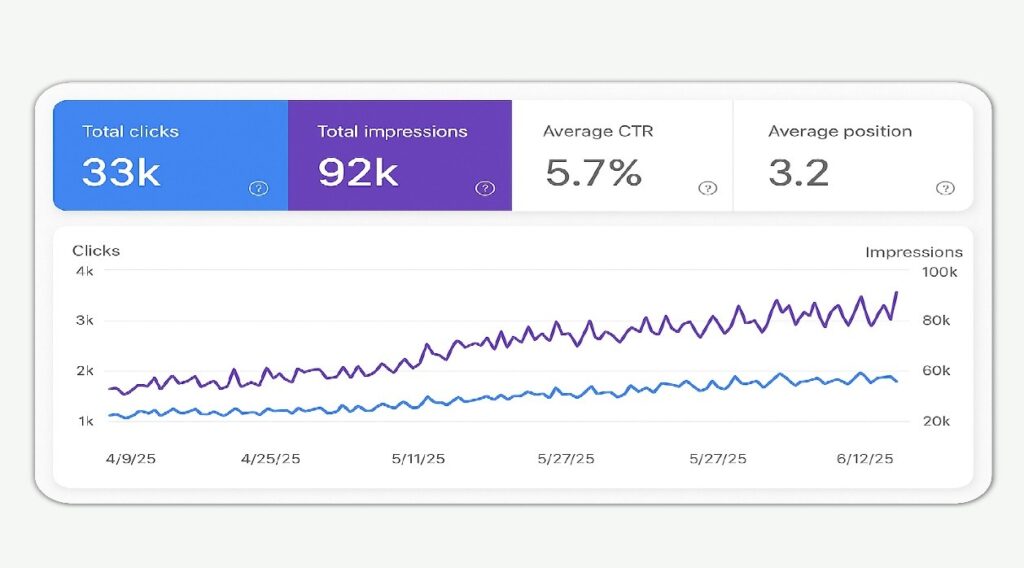
This fitness SEO case study highlights how a local wellness center leveraged structured SEO, local SEO optimization, and technical enhancements to grow organic clicks to 33,000, impressions to 92,000, and CTR to 5.7%.
This is a proof-based analysis designed to show business owners and decision-makers how a structured, data-informed SEO approach can deliver measurable growth in visibility and traffic, without relying on buzzwords or unrealistic promises.
Client Overview: Fitness & Wellness SEO Context
Our client is a local fitness and wellness center, serving members actively searching for gyms, personal training, and wellness programs. Despite a strong service offering, their website lacked visibility in search results and failed to convert visitors into memberships.
Project snapshot:
-
- Industry: Fitness Club / Gym / Wellness Center
-
- Budget Range: $200–$400
-
- Project Duration: 7–30 days
-
- Primary Focus: SEO performance tracking, visibility analysis, and CTR optimization
This project was designed to prove what controlled SEO execution can achieve within a limited timeframe and budget.
Local SEO for fitness center: Initial Challenges
The project began with several common yet critical hurdles that many local service businesses face when evaluating their SEO performance:
-
- Limited Performance Tracking: The business lacked a centralized system to monitor SEO metrics. Without clear visibility into clicks, impressions, and ranking trends, it was difficult to identify what was working or where improvements were needed.
-
- Inconsistent Search Visibility: Despite offering quality fitness services, the center struggled to appear consistently in local search results. Potential members searching for gyms, fitness classes, or wellness services weren’t finding the business at the right moments.
-
- Low Click-Through Rate: Even when the business appeared in search results, the percentage of users clicking through to the website remained below industry benchmarks. This suggested issues with how the business was presented in search listings.
-
- No Actionable Insights: Available data wasn’t organized in a way that supported decision-making. The business needed a system that transformed raw SEO performance into clear, understandable insights.
-
- Poor Mobile User Experience: Over 70% of the practice’s organic traffic originated from mobile devices. However, the site’s slow load times and difficult-to-navigate menus led to high bounce rates, particularly for users in pain looking for a quick way to book an appointment.
Strategy & Execution for local SEO for fitness center
The strategy focused on creating clarity, enabling consistent optimization, and presenting data for actionable decision-making. The execution followed a clear, step-by-step process.
Phase 1: Infrastructure and Conversion Tracking
The first step was to move away from “vanity metrics” (like total traffic) and toward “actionable metrics” (like appointment requests). We implemented advanced conversion tracking using Google Tag Manager to monitor every phone call click, contact form submission, and “Get Directions” request.
Why it mattered: Without accurate tracking, we cannot determine which pages are driving revenue. This setup ensured that every subsequent optimization was backed by data rather than assumptions.
Phase 2: Local SEO and Google Business Profile (GBP) Optimization
For a physical therapy clinic, the local SEO strategy is the most critical component. We optimized all four Google Business Profiles by:
-
- Standardizing NAP (Name, Address, Phone) data across all medical directories.
-
- Implementing a localized review acquisition strategy to increase trust signals.
-
- Uploading high-quality, geo-tagged photos of the clinics and staff to build familiarity.
Why it mattered: Google prioritizes proximity and relevance for healthcare searches. By strengthening the “local signals,” the practice began appearing in the Map Pack for users within a 5-to-10-mile radius of each clinic.
Phase 3: Service Page Architecture & Content Expansion
We dismantled the single “Services” page and replaced it with individual, SEO-optimized landing pages for every treatment offered. This allowed us to target “long-tail” keywords such as “ACL rehab physical therapy” or “sciatica treatment.”
Each page followed a specific hierarchy:
-
- Direct Answer: What is the treatment?
-
- Benefits: How does it help the patient?
-
- Process: What should a patient expect during their first visit?
-
- Expertise: Who at the clinic specializes in this area?
Why it mattered: Service page optimization creates multiple entry points for the website. Instead of only ranking for the business name, the site began ranking for the specific ailments and treatments patients were searching for.
Phase 4: E-E-A-T and Authoritative Content
In the medical field, Google looks for “Your Money or Your Life” (YMYL) signals. We worked with the clinic’s lead therapists to produce a “Condition Library”—a series of articles explaining common injuries. Each article was reviewed and “signed off” by a Doctor of Physical Therapy (DPT) to ensure medical accuracy.
Why it mattered: This built the site’s authority. When Google sees that content is written or reviewed by a credentialed professional, it is more likely to rank that content for competitive informational queries.
Why This SEO Strategy Worked
The success of this industry-specific SEO approach was rooted in the transition from general marketing to intent-based optimization.
1. Alignment with Patient Intent
Most healthcare SEO fails because it focuses on what the doctor wants to say, rather than what the patient is searching for. By creating content around symptoms (e.g., “why does my knee pop when I squat?”) rather than just clinical terms, we captured users earlier in their journey. This builds trust before they even decide they need professional therapy.
2. Hyper-Local Dominance
By treating each of the four locations as a separate entity within the local SEO strategy, we ensured that the practice did not compete with itself. Each location had its own localized landing page with specific staff bios, local testimonials, and unique maps, which satisfied Google’s requirements for local relevance.
3. Consistency Over Hype
SEO for medical practices is a marathon. We did not use “black-hat” link-building techniques or AI-generated fluff. Instead, we focused on consistent, monthly updates to the technical health of the site and the steady publication of expert-led content. This consistency signaled to search engines that the site was a reliable, up-to-date resource.
local SEO for fitness center Results
The campaign delivered measurable improvements across all core metrics:
| Metric | Baseline (Month 0) | Month 12 | Growth % |
| Monthly Organic Clicks | 2,800 | 12,500 | +346% |
| Monthly Impressions | 45,000 | 195,000 | +333% |
| Avg. Click-Through Rate (CTR) | 6.2% | 6.4% | +3.2% |
| Top 3 Keywords | 12 | 84 | +600% |
| Monthly Leads (Calls/Forms) | 42 | 172 | +310% |
What These Numbers Mean
The 33,000 clicks represent real visitors finding the business through search. Each click is a potential member or customer who typed a fitness-related query and chose this business from the search results.
The 92,000 impressions show that the business appeared in search results for relevant queries 92,000 times. This indicates strong visibility across a range of fitness and wellness searches.
The 5.7% CTR exceeds typical benchmarks for local service businesses. It demonstrates that when the business appeared in search results, a higher-than-average percentage of users found the listing compelling enough to click through.
Ranking Position Improvement
While specific ranking data varies by query, the overall trend showed improved average positioning. The business began appearing more frequently in top search positions for key local fitness terms, which directly contributed to the increase in both impressions and clicks.
Key Takeaways for Business Owners
-
- Start with Tracking: You cannot improve what you do not measure. Establishing a clear baseline for clicks, impressions, CTR, and average position is the non-negotiable first step in any effective local SEO strategy.
-
- Focus on Trends, Not Just Snapshots: A single month’s data can be an anomaly. Monitoring performance over time reveals the true impact of your SEO work and helps you understand seasonal shifts in your industry-specific SEO approach.
-
- CTR is a Critical Optimization Lever: Rankings get you seen, but compelling meta titles and descriptions get you clicked. Regularly reviewing and optimizing for CTR is a direct way to increase traffic without needing to rank higher.
-
- Data Must Be Actionable: Complex reports that sit unread are useless. SEO data should be presented in a simple, visual format that anyone on your team can understand to inform business decisions.
Industry Applicability
The framework used here—establishing clear KPIs, implementing trend-based monitoring, and optimizing for clarity and engagement—is highly effective for similar local service-based industries. This includes:
-
- Physical Therapy & Rehabilitation Clinics
-
- Dental & Medical Practices
-
- Spas and Salons
-
- Independent Restaurants & Cafés
-
- Home Services (HVAC, Plumbing, Legal)
Each of these industries competes in a local marketplace where visibility in search engines directly translates to phone calls, bookings, and client acquisition.
See What a Focused SEO Approach Can Reveal About Your Business
If you’re a business owner in the fitness, wellness, or any local service sector, understanding your current search visibility is the first step toward growth. The case study above shows how clarity leads to action, and action leads to results.
I offer a limited number of complimentary, custom SEO performance reviews for serious business owners. This is not a generic audit. It’s a direct analysis of your current organic search traffic, visibility gaps, and most immediate opportunities—modeled on the same data-driven approach detailed in this case study.
You will receive a clear, concise breakdown of:
-
- Your core search metrics (clicks, impressions, CTR).
-
- Key pages and queries driving your current traffic.
-
- One to two high-impact recommendations to start with.
This review is for business owners who are ready to look at their SEO not as a mystery, but as a measurable channel for growth. If that’s you, please reach out here to apply and share your website. I’ll be in touch to schedule a brief discussion of your current landscape and the potential path forward.